
You Started BHRT to Feel Like Yourself Again. Here’s How We Make Sure It’s Actually Working.
You didn’t start hormone therapy because you wanted to watch a number on a chart change. You started because you were tired of being tired. Because your body stopped responding the way it used to. Because you wanted your energy, your strength, and your focus back.
So here’s the real question: how do you know your dose is actually working?
The Scale Doesn’t Tell the Whole Story
Most people track their progress the only way they know how: a bathroom scale. But the scale has a blind spot big enough to hide real problems.
Two people can weigh exactly the same and be in completely different places. One might be carrying healthy muscle. The other might have quietly lost muscle and gained visceral fat, the kind that surrounds your organs and raises long-term health risks. The scale can’t tell you which one you are, and neither can BMI. Both simply add up pounds, whether those pounds are muscle, fat, or water.
That means it’s entirely possible to be on hormone therapy, doing everything right, and still have no real way of knowing whether your dose is helping, until months have passed and something still feels off.
That’s not a risk worth taking with your health.
You Deserve a Guide, Not a Guess
We’ve spent years helping patients through BHRT, and here’s what we’ve learned: dosing hormones based only on bloodwork and how a patient feels is guessing with good intentions. You deserve better than that. You deserve a provider who can show you, with real data, exactly what your treatment is doing to your body.
That’s why we don’t just prescribe your BHRT program and check back in a year. We measure it.
The Plan: A Body Composition Scan, Not a Guessing Game
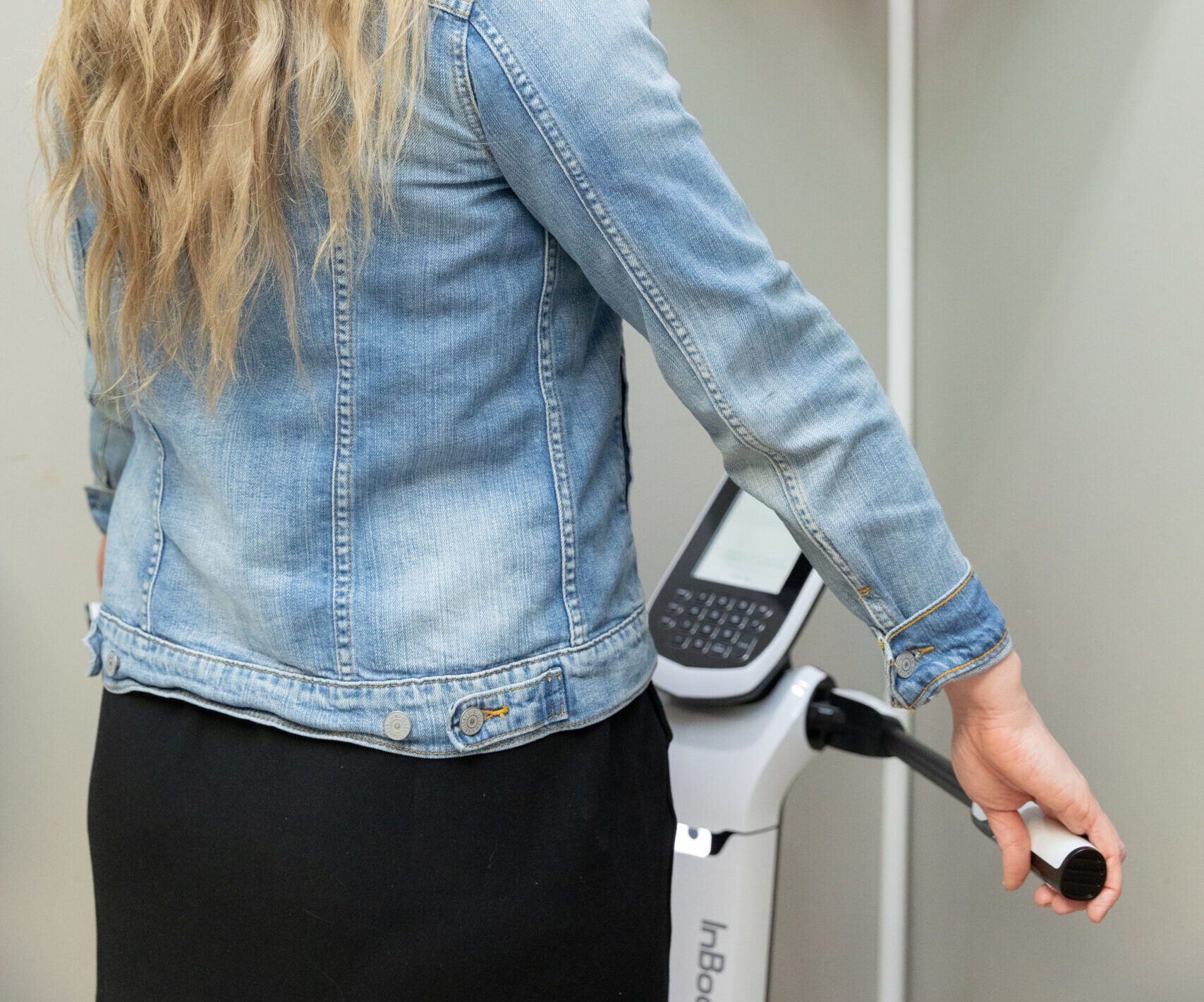
Here’s what that looks like in practice. Every patient in our BHRT program receives an InBody body composition scan at two key points:
- At the start of your program: so we have a real baseline, not an assumption.
- At your yearly renewal: so we can see, in clear numbers, how your body has changed since day one.
The scan itself takes about a minute. There are no needles, and nothing about it is invasive. You stand on the device and hold the hand sensors while a safe, low-level electrical current maps out exactly what you’re made of: fat mass, skeletal muscle, water, and minerals. From start to printed report, the whole visit takes five to ten minutes, and you walk away with something a scale could never give you: the truth.
Why This Step Matters for Your Dose
Here’s what the research shows, and why it’s relevant to your treatment specifically.
If you’re a man on testosterone therapy: The data backs up what your body is trying to do. In a randomized controlled trial published in BMC Medicine, men who received testosterone therapy lost significantly more fat and visceral fat than men on a placebo, and they regained lean muscle during the maintenance phase, while the placebo group didn’t. Other clinical studies show the same pattern: testosterone should be building your muscle and reducing your visceral fat over time. If a scan shows that isn’t happening, that’s a meaningful signal, not a minor detail, that your dose may need a second look.
If you’re a woman navigating perimenopause or menopause: Declining estrogen doesn’t just affect your cycle. It changes where your body stores fat and how much muscle it holds onto. Experts presenting at The Menopause Society’s Annual Meeting have pointed to declining estrogen as the primary driver behind a shift toward visceral, abdominal fat and away from lean muscle. A 2026 study in the Journal of Clinical Medicine found that postmenopausal women had significantly less lean mass and significantly more visceral fat than premenopausal women, across every body size, even women at a normal weight. These shifts often show up before the scale does. A body composition scan is often the first place we’ll see whether your estrogen therapy is protecting your muscle and controlling visceral fat, or whether it’s time to adjust.
For everyone: Hormones can also shift your fluid balance in ways you’d never notice day to day. Tracking your water levels helps us catch early signs of fluid retention before they become a bigger issue, something no scale and no symptom checklist can show us.
What Happens Without This Step
Without this data, here’s what can quietly happen: you stay on a dose that isn’t working.
Months pass. You lose muscle instead of building it. Visceral fat creeps up instead of down. You feel stuck, your bloodwork looks fine on paper, and nobody can explain why you’re not getting the results you were promised.
That’s exactly the outcome this step is designed to prevent.
What Success Looks Like
Success is a dose backed by proof, not hope. It’s walking into your renewal appointment and seeing real numbers that show your muscle is up and your visceral fat is down. It’s catching a problem early, adjusting before it turns into a plateau, and knowing, not guessing, that your treatment is working the way it’s supposed to.
If We’re Not in Your Area, Ask This One Question
Not everyone reading this is our patient, and that’s okay. If our practice isn’t near you, do yourself one favor before you start or continue BHRT elsewhere: ask your provider how they track body composition throughout your treatment.
If the answer is simply “we’ll weigh you,” keep looking. A provider who relies only on a scale is working with half the picture. Look for one who uses a real body composition tool, like BIA or DEXA, at your baseline and at regular intervals afterward, so your dose is backed by data, not a guess.
You started this journey to get your life back. Make sure the people guiding you can actually prove it’s working.
Sources
Ng Tang Fui, M., et al. “Effects of testosterone treatment on body fat and lean mass in obese men on a hypocaloric diet: a randomised controlled trial.” BMC Medicine (2016).
Frontiers in Endocrinology, “Baseline Testosterone Predicts Body Composition and Metabolic Response to Testosterone Therapy” (2022).
Allan, C.A., et al. “Testosterone Therapy Prevents Gain in Visceral Adipose Tissue and Loss of Skeletal Muscle in Nonobese Aging Men.” Journal of Clinical Endocrinology & Metabolism (2008).
Szeliga, A., Chedraui, P., Meczekalski, B. “The Impact of the Menopausal Transition on Body Composition and Abdominal Fat Redistribution.” Journal of Clinical Medicine (2026).
Contemporary OB/GYN, coverage of Brooke Aggarwal, EdD, presentation at The Menopause Society Annual Meeting (2025).
University Hospitals, “The Connection Between Menopause & Belly Fat.”
This article is for general educational purposes and is not a substitute for individualized medical advice. Body composition results should always be interpreted by a qualified healthcare provider in the context of your full clinical picture.